This timeline is historical documentation compiled through secondary research. Entries draw on published histories of the Indian women's movement, official policy records, and public documentation of philanthropic developments; each is sourced in the accompanying annotated bibliography. References to movements, advocacy, policy developments, organizations or funders are descriptive and do not indicate Dasra's endorsement, participation, funding or institutional position. Dates and descriptions reflect the cited sources and are not independent findings. The sources for these events can be found here.
This timeline is historical documentation compiled through secondary research. Entries draw on published histories of the Indian women's movement, official policy records, and public documentation of philanthropic developments; each is sourced in the accompanying annotated bibliography. References to movements, advocacy, policy developments, organizations or funders are descriptive and do not indicate Dasra's endorsement, participation, funding or institutional position. Dates and descriptions reflect the cited sources and are not independent findings. The sources for these events can be found here.
movements and civil society
movements and civil society
Building the scaffolding. independence, institutions, and early frameworks
UN Commission on the Status of Women (CSW)
was established as a functional commission of ECOSOC.
The Hindu Succession Act
enhanced women's property rights, though some concerns persisted.
UN Commission on the Status of Women (CSW)
was established as a functional commission of ECOSOC.
The Hindu Succession Act
enhanced women's property rights, though some concerns persisted.
MOVEMENTS & CIVIL SOCIETY
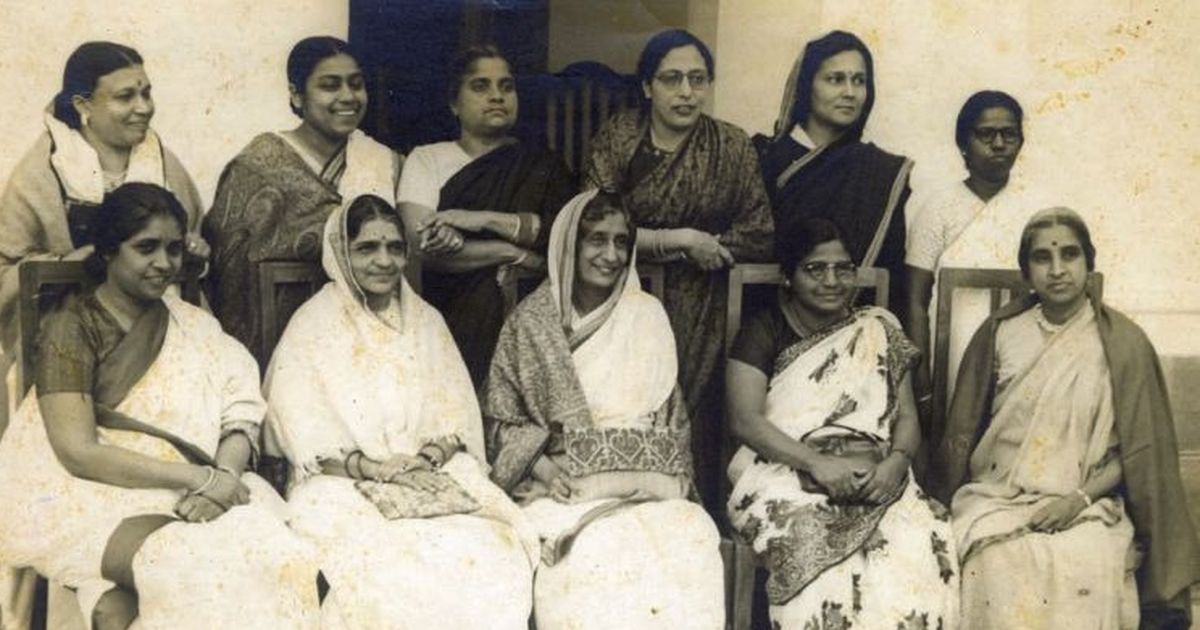
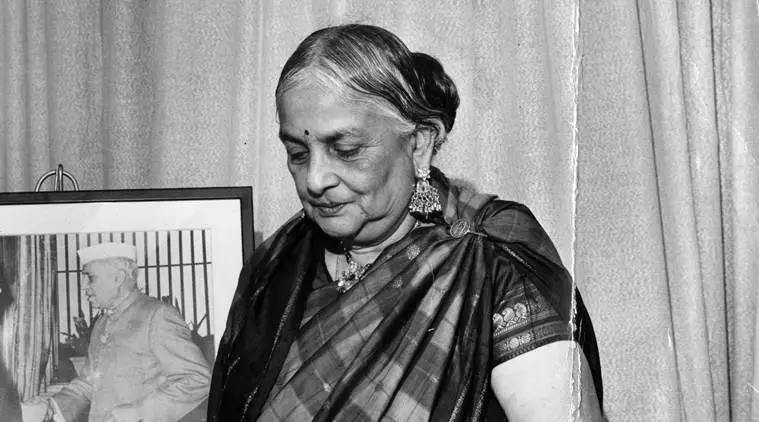
Nationalist women leaders
Sarojini Naidu, Aruna Asaf Ali, Sucheta Kripalani and Vijaya Lakshmi Pandit were central figures. Approximately 17,000 women were imprisoned during the Civil Disobedience Movement.
Philanthropy led by business families
invested in girls' education, health, and social services. Community trusts supported girls' schools and maternal health clinics.
Kamaladevi Chattopadhyay
supported women’s livelihoods through institutions (Indian Co-operative Union, Crafts Council of India, National School of Drama).
Philanthropy led by business families
invested in girls' education, health, and social services. Community trusts supported girls' schools and maternal health clinics.
Kamaladevi Chattopadhyay
supported women’s livelihoods through institutions (Indian Co-operative Union, Crafts Council of India, National School of Drama).
Welfare, not yet rights – the state sets minimums, philanthropy follows
Dowry Prohibition Act enacted
Maternity Benefit Act, 1961
mandated paid maternity leave and prohibited dismissal during pregnancy.
MOVEMENTS & CIVIL SOCIETY
'Women in Development' (WID) Approach
began to take shape, recognizing women as economic agents. Development theory globally still treated women as passive beneficiaries.
MOVEMENTS & CIVIL SOCIETY
STUDENT, PEASANT AND ANTI-CASTE MOVEMENTS
emerged through the decade, providing a platform from which urban educated women began to organize into autonomous groups.
Philanthropic attention remained welfare oriented
supporting literacy campaigns, maternal and child health (MCH) and vocational training.
global frameworks meet grassroots momentum
The Committee on the Status of Women in India
submitted its report, Towards Equality, in 1974, documenting the deterioration in women's status since Independence across health, education, employment and political representation.
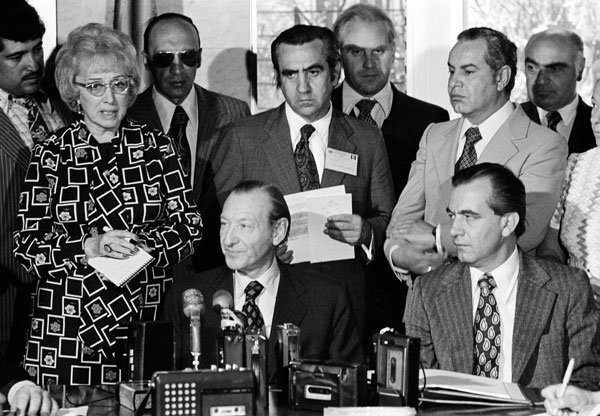
First UN World Conference on Women
held in Mexico City. UN Decade for Women declared (1976–85).
The Convention on the Elimination of All Forms of Discrimination Against Women (CEDAW)
The Equal Remuneration Act
mandated equal pay for equal work.
MOVEMENTS & CIVIL SOCIETY
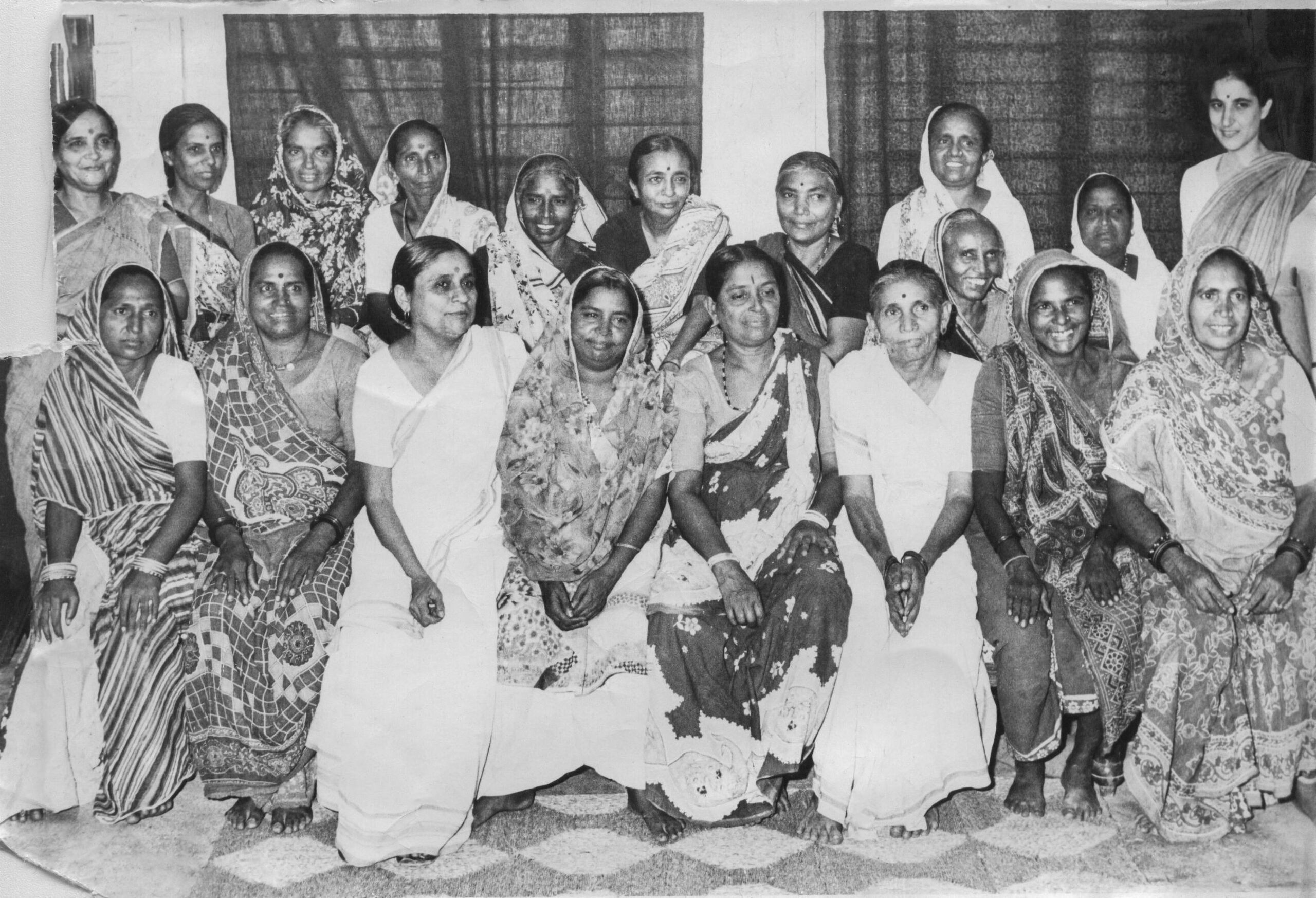
SEWA registered as a trade union
Ela Bhatt stood alongside poor migrant handcart-pullers and headloaders in Ahmedabad's cloth market, listening to their struggles.
MOVEMENTS & CIVIL SOCIETY
Chipko Movement
Gaura Devi led 27 women in Uttarakhand to hug trees and protect felling. A landmark of ecofeminism and was followed by the implementationIndia's Forest Conservation Act (1980).
MOVEMENTS & CIVIL SOCIETY
Campaigns Against Dowry Deaths
The Autonomous Women’s Movement emerges, with collectives such as Saheli and Manushi spearheading anti-dowry and anti-rape campaigns.
Growth of International funding
with Ford Foundation, Oxfam, and USAID, under the Percy Amendment, supporting Indian women’s organizations.
SEWA developed 'solidarity-based' models
of resourcing, with low-income women pooling savings to build member-owned institutions such as the SEWA Bank and cooperatives.
The Committee on the Status of Women in India
submitted its report, Towards Equality, in 1974, documenting the deterioration in women's status since Independence across health, education, employment and political representation.
The Convention on the Elimination of All Forms of Discrimination Against Women (CEDAW)
First UN World Conference on Women
held in Mexico City. UN Decade for Women declared (1976–85).
The Equal Remuneration Act
mandated equal pay for equal work.
MOVEMENTS & CIVIL SOCIETY
SEWA registered as a trade union
Ela Bhatt stood alongside poor migrant handcart-pullers and headloaders in Ahmedabad's cloth market, listening to their struggles.
MOVEMENTS & CIVIL SOCIETY
Campaigns Against Dowry Deaths
The Autonomous Women’s Movement emerges, with collectives such as Saheli and Manushi spearheading anti-dowry and anti-rape campaigns.
MOVEMENTS & CIVIL SOCIETY
Chipko Movement
Gaura Devi led 27 women in Uttarakhand to hug trees and protect felling. A landmark of ecofeminism and was followed by the implementationIndia's Forest Conservation Act (1980).
Growth of International funding
with Ford Foundation, Oxfam, and USAID, under the Percy Amendment, supporting Indian women’s organizations.
SEWA developed 'solidarity-based' models
of resourcing, with low-income women pooling savings to build member-owned institutions such as the SEWA Bank and cooperatives.
Grassroots organizing takes shape – collectives, SHGs, and the first women's funds
Third UN World Conference on Women (Nairobi)
adopted the Forward-Looking Strategies for the Advancement of Women to 2000.
National Education Policy
recognized education as an instrument of women's empowerment.
The Mahila Samakhya Programme was launched,
building village-level sanghams using participatory methods for 'education for women's equality'.
Third UN World Conference on Women (Nairobi)
adopted the Forward-Looking Strategies for the Advancement of Women to 2000.
The Mahila Samakhya Programme was launched,
building village-level sanghams using participatory methods for 'education for women's equality'.
National Education Policy
recognized education as an instrument of women's empowerment.
MOVEMENTS & CIVIL SOCIETY
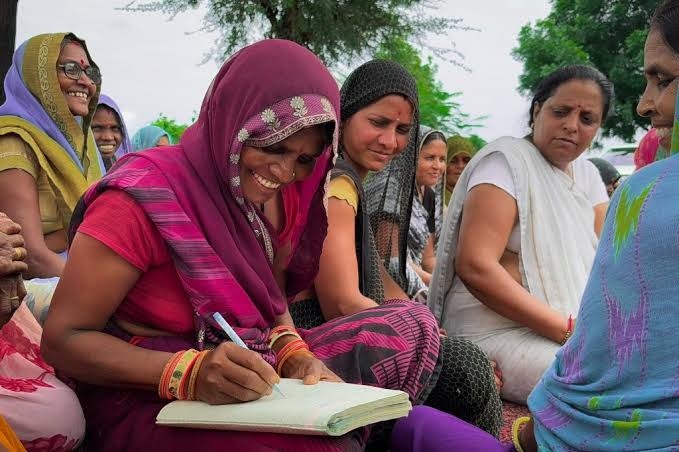
NABARD piloted an SHG-Bank Linkage Programme
connecting women's savings groups to formal credit. SHGs emerged as the core unit of grassroots women's organizing, a financial tool, a social platform, and a vehicle for collective action.
MOVEMENTS & CIVIL SOCIETY
THE MAHILA SAMAKHYA PROGRAMME WAS LAUNCHED
as a community-based poverty eradication and women’s empowerment mission.
MOVEMENTS & CIVIL SOCIETY
NABARD piloted an SHG-Bank Linkage Programme
connecting women's savings groups to formal credit. SHGs emerged as the core unit of grassroots women's organizing, a financial tool, a social platform, and a vehicle for collective action.
MOVEMENTS & CIVIL SOCIETY
THE MAHILA SAMAKHYA PROGRAMME WAS LAUNCHED
as a community-based poverty eradication and women’s empowerment mission.
Mama Cash was founded in the Netherlands
the first international women's fund, according to Mama Cash. By 1985, around 35 women's funds were in some stage of development.
MacArthur Foundation began grantmaking in India
primarily supporting work to reduce maternal mortality, advance SRHR for young people, and improve girls' secondary education.
The Global Fund for Women
supported the emergence of other women's funds, such as the African Women's Development Fund.
Mama Cash was founded in the Netherlands
the first international women's fund, according to Mama Cash. By 1985, around 35 women's funds were in some stage of development.
The Global Fund for Women
supported the emergence of other women's funds, such as the African Women's Development Fund.
MacArthur Foundation began grantmaking in India
primarily supporting work to reduce maternal mortality, advance SRHR for young people, and improve girls' secondary education.
Scale and legitimacy – SHGs expand, Beijing sets the global agenda
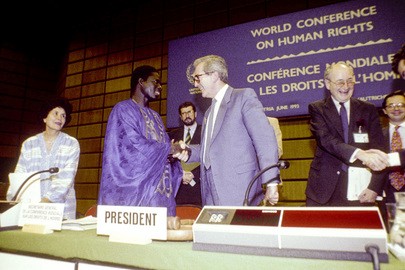
Vienna Declaration
affirmed that women's rights are universal human rights.
INTERNATIONAL CONFERENCE ON POPULATION AND DEVELOPMENT Cairo, Programme of Action
centred women's right to decide on number, spacing, and timing of children.
Beijing Platform for Action (BPfA)
was adopted by 189 states. It remains the most comprehensive global framework for women's equality.
Vishaka Guidelines
mandate workplace mechanisms to address sexual harassment in India.
International Day for the Elimination of Violence Against Women
was designated by the UN to be observed on 25 November.
Vienna Declaration
affirmed that women's rights are universal human rights.
Beijing Platform for Action (BPfA)
was adopted by 189 states. It remains the most comprehensive global framework for women's equality.
International Day for the Elimination of Violence Against Women
was designated by the UN to be observed on 25 November.
INTERNATIONAL CONFERENCE ON POPULATION AND DEVELOPMENT Cairo, Programme of Action
centred women's right to decide on number, spacing, and timing of children.
Vishaka Guidelines
mandate workplace mechanisms to address sexual harassment in India.
MOVEMENTS & CIVIL SOCIETY
NABARD's SHG-Bank Linkage Programme
scaled rapidly. Thousands of SHGs operationalized by late 1990s, concentrated in Andhra Pradesh, Tamil Nadu, and Kerala.
International philanthropic infrastructure
deepened through the decade, strengthening institutional capacity in Indian women's organizations.
Mainstreaming at scale – policy expands, campaigns go mass
UN MILLENNIUM DEVELOPMENT GOALS adopted Goal 3
targeting gender parity in education by 2005 and at all levels by 2015.
India's National Policy for Empowerment of Women
emphasized gender budgeting.
Protection of Women from Domestic Violence Act (PWDVA)
established the first broad civil framework and contains a comprehensive definition of the term 'Domestic Violence' including economic and emotional abuse.
India's first Gender Budget Statement launched
UN MILLENNIUM DEVELOPMENT GOALS adopted Goal 3
targeting gender parity in education by 2005 and at all levels by 2015.
Protection of Women from Domestic Violence Act (PWDVA)
established the first broad civil framework and contains a comprehensive definition of the term 'Domestic Violence' including economic and emotional abuse.
India's National Policy for Empowerment of Women
emphasized gender budgeting.
India's first Gender Budget Statement launched
MOVEMENTS & CIVIL SOCIETY
Women’s inclusion in Watershed Committees (ICRISAT)
formalized through sustained engagement, though decision-making participation remained uneven.
MOVEMENTS & CIVIL SOCIETY
Bell Bajao!' (Ring the Bell)
Breakthrough launched a media campaign calling on men and boys to speak out against domestic violence, reaching over 130 million viewers across India.
Women Moving Millions (WMM) launched
A campaign for philanthropic gifts of USD 1 million or more for women and girls, raised over USD 174 million from 95 members between 2007 and 2009.
Gender mainstreaming
entered philanthropic vocabulary; funders began requiring gender analysis in grantee proposals and program design.
Mandates and momentum – CSR, SDGs, and digital feminist activism
UN Women
established by unanimous vote of the UN General Assembly.
India’s Companies Act (Section 135)
made India the first country to mandate CSR spending, at 2% of net profit. 'Promoting gender equality and empowering women' was listed as an eligible activity.
NALSA judgment
Supreme Court recognized transgender persons as a third gender.
SDG 5
adopted – Achieve gender equality and empower all women and girls.
Beti Bachao Beti Padhao
scheme launched to address declining child sex ratios.
UN Women
established by unanimous vote of the UN General Assembly.
NALSA judgment
Supreme Court recognized transgender persons as a third gender.
Beti Bachao Beti Padhao
scheme launched to address declining child sex ratios.
India’s Companies Act (Section 135)
made India the first country to mandate CSR spending, at 2% of net profit. 'Promoting gender equality and empowering women' was listed as an eligible activity.
SDG 5
adopted – Achieve gender equality and empower all women and girls.
MOVEMENTS & CIVIL SOCIETY
Gender lens investing
emerged as a distinct field, integrating gender analysis into investment decisions.
MOVEMENTS & CIVIL SOCIETY
Digital feminist platforms
like Feminism in India, The Ladies Finger, and Agents of Ishq expanded the reach and accessibility of gender discourse.
MOVEMENTS & CIVIL SOCIETY
Campaign 'Pinjra Tod'
raised questions about curfew rules in university hostels in Delhi. [Campaign material produced by Pinjra Tod]
MOVEMENTS & CIVIL SOCIETY
WHY LOITER
focused on gendered restrictions on women's use of public spaces.
MOVEMENTS & CIVIL SOCIETY
Gender lens investing
emerged as a distinct field, integrating gender analysis into investment decisions.
MOVEMENTS & CIVIL SOCIETY
Campaign 'Pinjra Tod'
raised questions about curfew rules in university hostels in Delhi. [Campaign material produced by Pinjra Tod]
MOVEMENTS & CIVIL SOCIETY
Digital feminist platforms
like Feminism in India, The Ladies Finger, and Agents of Ishq expanded the reach and accessibility of gender discourse.
MOVEMENTS & CIVIL SOCIETY
WHY LOITER
focused on gendered restrictions on women's use of public spaces.
Mandatory CSR
created a large new pool of corporate funding for women’s initiatives, though much of it remains welfare oriented.
Infrastructure for philanthropy
deepens in India with rise of intermediaries, pooled funds, giving circles, knowledge platforms, advisory services, etc.
Mandatory CSR
created a large new pool of corporate funding for women’s initiatives, though much of it remains welfare oriented.
Infrastructure for philanthropy
deepens in India with rise of intermediaries, pooled funds, giving circles, knowledge platforms, advisory services, etc.
Fragility and acceleration – pandemic shock, POLICY SHIFTS, and expanding cohort of funders
COVID19's shadow pandemic
UN Women document a rise in GBV, unpaid care, job losses, and SRHR disruptions.
Federal right to abortion
India's Constitutional Amendment (2023)
reserved one-third of seats for women in Lok Sabha and State assemblies, including SC/ST quotas.
COVID19's shadow pandemic
UN Women document a rise in GBV, unpaid care, job losses, and SRHR disruptions.
India's Constitutional Amendment (2023)
reserved one-third of seats for women in Lok Sabha and State assemblies, including SC/ST quotas.
Federal right to abortion
MOVEMENTS & CIVIL SOCIETY
Feminist digital organizing
accelerated through the pandemic, with mutual aid networks and online communities scaling rapidly.
MOVEMENTS & CIVIL SOCIETY
A CHANGING INTERNATIONAL FUNDING ENVIRONMENT
Shifts in international policy on reproductive health affected the funding available to women's rights organizations during this period.
MOVEMENTS & CIVIL SOCIETY
Feminist digital organizing
accelerated through the pandemic, with mutual aid networks and online communities scaling rapidly.
MOVEMENTS & CIVIL SOCIETY
A CHANGING INTERNATIONAL FUNDING ENVIRONMENT
Shifts in international policy on reproductive health affected the funding available to women's rights organizations during this period.
Women’s funds globally
responded in COVID-19, deploying flexible grants to frontline feminist groups like Urgent Action Fund.
Gender Fund
launched by Co-Impact for women-led organizations in the Majority World.
The EdelGive Hurun India Philanthropy List 2025
counted 24 women among 191 philanthropists, who collectively donated INR 10,380 crore in FY2025. Women are increasingly shaping philanthropic decisions in Indian families.
Women’s funds globally
responded in COVID-19, deploying flexible grants to frontline feminist groups like Urgent Action Fund.
The EdelGive Hurun India Philanthropy List 2025
counted 24 women among 191 philanthropists, who collectively donated INR 10,380 crore in FY2025. Women are increasingly shaping philanthropic decisions in Indian families.
Gender Fund
launched by Co-Impact for women-led organizations in the Majority World.